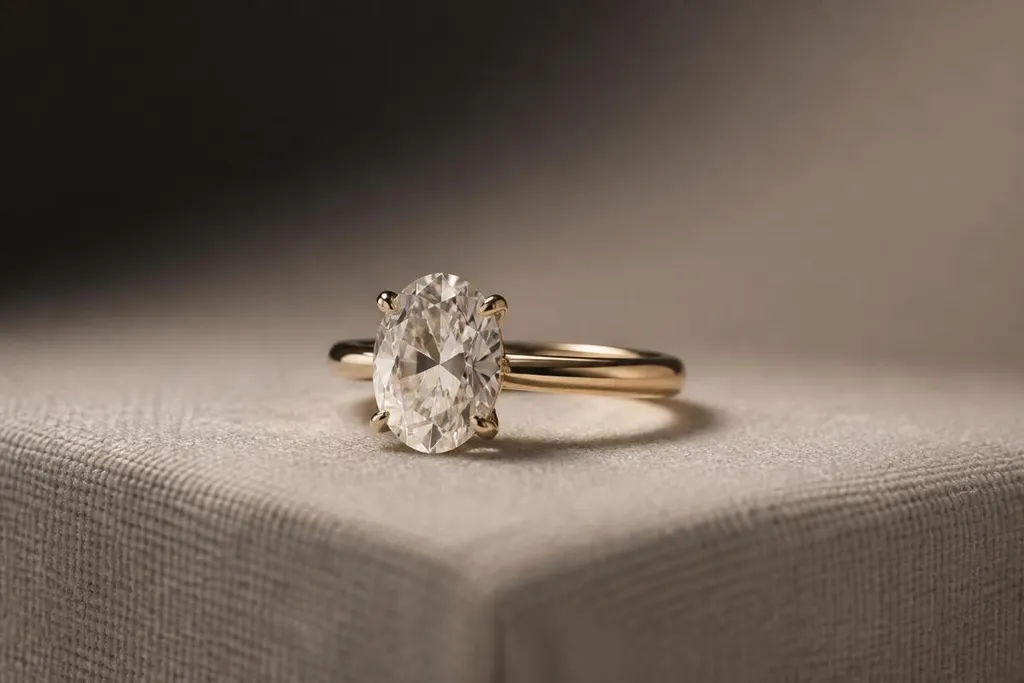
A two-carat centre stone has enough presence to define an engagement ring before the finer details are even noticed. That does not mean bigger automatically looks better. At this scale, proportion becomes particularly important: the diamond's shape, visible dimensions, band width and setting height all determine whether the finished ring feels elegant, dramatic or unnecessarily heavy.
For couples comparing certified 2 carat engagement rings, the most useful approach is to treat carat weight as one part of the design rather than the final objective. Certification provides valuable information about a diamond's characteristics, but two stones carrying the same two-carat weight can present quite differently on the hand. The right choice is ultimately about balancing measurable quality with shape, setting and everyday wearability.
Understand What Two Carats Looks Like in Different Shapes
Carat measures weight, not visible size. How a two-carat diamond distributes that weight determines its face-up dimensions and therefore its apparent scale.
Round brilliant diamonds create a balanced, symmetrical presence. Oval, pear and marquise cuts distribute more of their outline lengthways, which can provide generous coverage along the finger and create a visually elongating effect.
Cushion cuts often have a fuller appearance, while radiant cuts combine a strong geometric outline with lively faceting. Emerald cuts offer a very different interpretation of two carats. Their long step facets and clean lines make dimensions and proportion particularly noticeable.
Personal preference should guide the choice. Someone may select a two-carat oval because its length complements their fingers, while another person might prefer a two-carat round because the more compact outline feels better balanced. In both cases, the decision involves proportion rather than size alone.
Use Certification to Compare the Details
Certification provides a structured basis for comparing diamonds of similar carat weight. Information such as measurements, colour, clarity and other grading characteristics can help identify meaningful differences between stones.
However, the highest grades are not automatically the best allocation of a budget.
An eye-clean diamond with a carefully chosen clarity grade may provide the appearance a wearer wants without paying for microscopic characteristics that cannot be appreciated without magnification. Colour can similarly be considered in relation to the setting metal rather than in isolation.
At two carats, cut and proportion deserve particular attention because the stone is visually prominent. A beautifully proportioned diamond that handles light effectively can be more compelling than one chosen primarily for a higher colour or clarity grade.
Actual millimetre measurements are useful too. Two diamonds weighing approximately two carats can differ in visible length and width depending on their shape and depth.
Choose a Setting That Supports the Centre Stone
A two-carat diamond already has considerable visual presence, so the setting does not necessarily need to be elaborate.
A solitaire creates a clean composition and allows the centre stone's shape to remain completely dominant. A fine band can heighten that effect through contrast, although the band should still feel structurally and visually appropriate for the scale of the diamond.
Diamond-set shoulders add brightness without substantially increasing the overall footprint. For someone seeking a more decorative result, a halo can make the ring considerably broader and more dramatic.
Trilogy designs require particularly careful proportion. Side stones should complement the centre rather than compete with it, creating a gradual and intentional transition across the finger.
Setting height is equally important. A high-profile two-carat stone can feel very prominent and may catch more easily during everyday activities. A thoughtfully designed lower or moderate profile may offer a more practical balance for regular wear.
Consider the Hand, Metal and Wedding Band
A ring should be assessed on the hand rather than solely through close-up product photography. Finger length and width can influence how substantial a two-carat stone feels.
Band width provides another means of adjusting balance. A slender band emphasises the centre diamond, while a broader band can make the overall design feel more grounded.
Metal also changes the aesthetic. Platinum and white gold create a cool, seamless backdrop around colourless stones. Yellow gold introduces warmer contrast, while rose gold softens the overall composition.
It is worth thinking ahead to the wedding band as well. The engagement ring's gallery, setting height and band profile determine whether a straight wedding ring can sit closely beside it or whether a shaped design will create a better fit.
Final Thought
Two-carat engagement rings naturally attract attention, but their success depends on much more than scale. Shape, face-up dimensions, certification, setting and band proportions all influence whether that presence feels balanced.
Rather than choosing a two-carat diamond simply because it is larger than a one-carat alternative, consider what the additional size contributes to the complete design. When every element works together, a two-carat engagement ring can feel substantial and luxurious while remaining refined enough for a lifetime of everyday wear.